Mud Terrain Tyres Perth: Are They Right for Your 4WD?
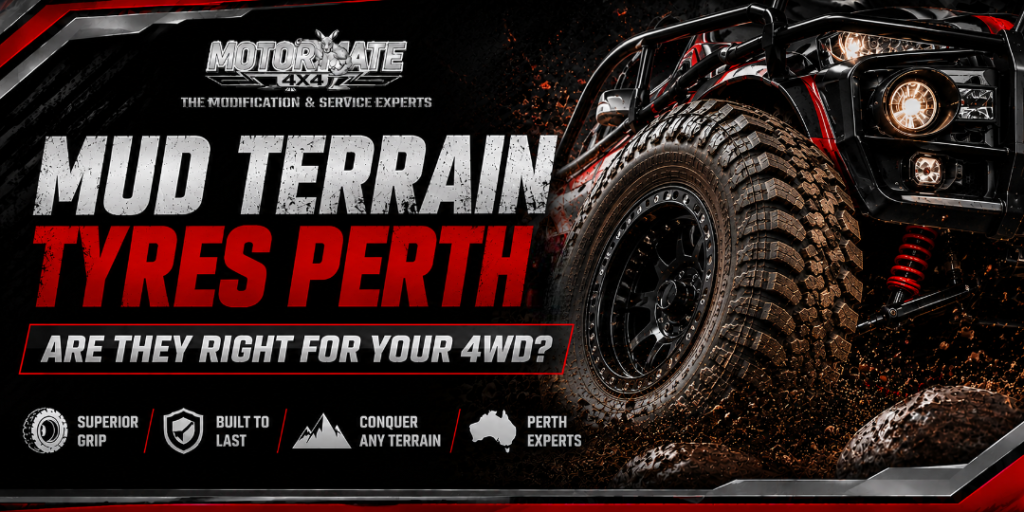
Table of Contents
Mud terrain tyres can be the right choice for a 4WD that regularly tackles deep mud, rocky tracks and difficult off-road conditions. But if your vehicle spends most of its time on Perth roads, an all-terrain tyre may give you a better balance of grip, comfort, noise and everyday drivability. The best choice depends on where you drive, how often you go off-road and what you expect from your 4WD.
This guide breaks down what mud terrain tyres are, how they perform on Western Australian terrain, what to look for in a quality set, and how to know if they’re the right upgrade for your vehicle before you commit.
Are Mud Terrain Tyres Right for Your 4WD?
Mud terrain tyres are worth considering when serious off-road traction is a regular need, rather than an occasional bonus.
Mud Terrain, also known as M/T tyres, use a deep, open tread pattern with large blocks and wide spaces between them. This gives the tread room to clear mud and loose material while helping the tyre maintain contact with the ground.
That design is useful when a track becomes slippery, soft or heavily rutted. The trade-off is that the same aggressive tread can be louder and less comfortable on sealed roads than a tyre designed for mixed driving.
So the first question is not which M/T tyre looks toughest. It is how you actually use your 4WD.
If you commute around Perth during the week and only drive on easy gravel tracks a few times a year, an all-terrain setup may make more sense. If your weekends regularly involve muddy tracks, rocky terrain or difficult off-road sections, the extra traction from M/T tyres can justify the compromises.
That is the key decision behind choosing mud terrain tyres for 4WD use.
What Makes Mud Terrain Tyres Different?
Mud terrain tyres are designed around traction in soft and difficult terrain, using aggressive tread blocks and open grooves that help clear mud as the tyre rotates.
Look at an M/T tyre and the difference is obvious. The tread blocks are larger and more widely spaced than those found on a road-focused tyre.
Those gaps have a practical purpose. When mud packs into a tyre’s tread, the tyre can lose its ability to grip the surface. An open pattern gives mud and debris somewhere to go, allowing the tread blocks to keep working.
The construction is also aimed at off-road use. Depending on the tyre specification, stronger sidewalls and heavier construction can provide greater resistance to cuts and impacts when travelling over rough ground.
But there is no free performance gain.
A tyre designed to work hard in mud is making a different set of compromises from one designed primarily for quiet highway driving. The tread can produce more noise, the tyre can weigh more, and the road feel can change.
That is why choosing an M/T tyre should be based on your driving conditions rather than appearance alone.
Why Do Perth Drivers Choose Mud Terrain Tyres?
Perth 4WD owners generally consider mud terrain tyres when their driving includes soft, muddy, rocky or uneven tracks where ordinary road-focused tyres struggle for traction.
Western Australia’s off-road conditions can vary considerably. A track that feels easy in dry weather can become much more difficult after rain, while loose surfaces, ruts and rocks can place extra demands on your tyres.
For that type of driving, M/T tyres offer several useful characteristics:
- Open tread: Helps clear mud and loose debris.
- Large tread blocks: Provide more aggressive contact with soft surfaces.
- Off-road construction: Can offer greater resistance to damage on rough tracks, depending on the tyre.
- Strong traction: Particularly useful in mud and other loose terrain.
- Off-road focus: Designed around conditions where maintaining grip is the priority.
It is worth separating mud driving from sand driving, though.
Beach and dune driving depends heavily on tyre pressure, vehicle weight, wheel setup and driving technique. An aggressive tread pattern alone does not guarantee better performance in sand.
If your main use is beach touring rather than mud, your tyre decision should reflect that.
Mud Terrain vs All-Terrain Tyres: Which Should You Buy?
All-terrain tyres are usually the stronger choice for mixed road and off-road driving, while M/T tyres make more sense when difficult off-road terrain is a regular part of your 4WD use.
Factor | All-Terrain Tyres | Mud Terrain Tyres |
Daily sealed-road driving | Strong choice | More compromised |
Mud | Good | Excellent focus |
Gravel and dirt | Good | Good |
Difficult off-road terrain | Good | Strong |
Road noise | Lower | Higher |
Ride comfort | Generally better | Generally firmer |
Fuel consumption | Generally more favourable | Can be higher |
Off-road focus | Balanced | High |
Best suited to | Mixed use | Regular serious off-road use |
Australian 4WD testing and specialist content consistently point to the same basic trade-off: M/T tyres can provide advantages in mud and difficult terrain, but those gains can come with compromises in road noise, wet-road behaviour, fuel use and comfort.
For a Perth 4WD used for commuting, touring and occasional tracks, an all-terrain tyre may therefore be the more practical choice.
Motor Mate 4×4 currently lists all-terrain tyres as part of its 4WD tyre offering, with vehicle-specific options such as Toyota Hilux tyres and Isuzu D-Max tyres. Its main tyre range is positioned around grip, control and performance across changing terrain.
What Are the Main Benefits of Mud Terrain Tyres?
The biggest advantage of mud terrain tyres is their ability to maintain useful traction when the surface becomes soft, muddy or technically difficult.
Better Mud Traction
The large tread blocks can bite into soft ground while the open spaces help clear mud from the tread.
That is the main reason M/T tyres exist. When the track is genuinely muddy, tread design becomes far more important than it is on a sealed road.
Greater Off-Road Capability
M/T tyres are also suited to rougher tracks where loose dirt, rocks and ruts make maintaining traction difficult.
The aggressive tread can help the tyre continue finding grip as the surface changes.
More Robust Construction
Off-road driving exposes tyres to hazards they rarely encounter on normal roads. Sharp rocks, roots and rough edges can place considerable stress on the tread and sidewalls.
The construction of a particular tyre matters here, so check its specifications rather than assuming every M/T tyre offers the same level of protection.
More Confidence in Difficult Conditions
There is also a practical benefit. Knowing your tyres are designed for the terrain ahead can make it easier to approach difficult sections with the right vehicle setup and tyre pressures.
That does not replace good 4WD technique, but tyres are an important part of the overall setup.
What Are the Downsides of M/T Tyres on Sealed Roads?
The biggest compromises with M/T tyres are increased road noise, extra weight, potentially higher fuel consumption and less road-focused performance.
The difference is easiest to notice when your 4WD is used as a daily driver.
More Road Noise
Large tread blocks and open grooves can create a noticeable hum, particularly as speed increases.
For someone who spends a lot of time on Perth highways, this may become frustrating.
Higher Rolling Resistance
M/T tyres can be heavier and have a more aggressive tread than all-terrain alternatives. That can increase rolling resistance and contribute to higher fuel consumption.
The actual difference varies between tyres, vehicles and driving conditions, so it should be treated as a potential trade-off rather than a fixed percentage.
Different Road Handling
The steering and ride can feel different after changing to a heavier, more aggressive tyre.
Wet sealed roads also deserve attention. An M/T tyre designed primarily around mud performance does not necessarily provide the same road behaviour as a tyre designed for mixed use.
Faster Wear in the Wrong Environment
Using an M/T tyre predominantly on bitumen means you are asking it to spend most of its life away from the conditions it was designed to handle.
If serious off-road driving is only an occasional event, an all-terrain tyre may deliver better value over the life of the set.
How Do You Choose the Best Mud Terrain Tyres for a 4WD?
The best mud terrain tyres for your 4WD should match the vehicle, tyre size, load requirements and terrain you actually drive.
Start with the basics:
- Check the size: The tyre needs to be compatible with your wheels and vehicle. Larger tyres can create clearance and fitment issues if the vehicle has not been set up for them.
- Check the load rating: If you tow, carry tools or travel with a heavily loaded 4WD, the tyre needs to be appropriate for the vehicle’s operating weight.
- Consider the tread pattern: Don’t choose the most aggressive tread simply because it looks capable. Think about whether you actually spend enough time in mud to benefit from it.
- Think about road kilometres: A tyre that works brilliantly on tracks can become an irritating choice if most of your driving is a daily commute.
- Check the complete wheel setup: Wheel size, offset, suspension changes and tyre dimensions can all affect fitment.
Motor Mate 4×4’s vehicle-specific approach is useful here. Its Toyota Hilux tyres, for example, are listed with multiple sizes and advise customers to confirm their model year and current wheel size before selecting the correct specification.
That fitment-first approach is worth following regardless of which tyre type you choose.
Are Mud Terrain Tyres Worth It for Everyday Perth Driving?
M/T tyres are worth the compromise for everyday driving when your 4WD regularly leaves the road and needs their off-road strengths; otherwise, an all-terrain tyre may be the smarter choice.
Think about your last ten trips.
If nine were commuting, shopping, school runs, and freeway driving and one was an easy dirt track, you probably do not need a highly specialised mud tyre.
If several of those trips involved difficult tracks, mud or rough terrain, the balance changes.
This is why there is no single answer to the question of whether M/T tyres are “better”. A tyre can be excellent for one driver’s needs and completely unnecessary for another.
Motor Mate 4×4’s current range reflects this mixed-use market, with all-terrain tyres offered for 4WD applications where drivers need road manners alongside off-road capability.
What Should Perth 4WD Owners Check Before Fitting New Tyres?
Before fitting new tyres, check size, load rating, wheel compatibility, clearance and how the tyre will affect your vehicle’s overall setup.
This matters even more if your 4WD has already been modified.
A suspension lift, aftermarket wheels or other changes can affect which tyre sizes will fit correctly. The safest approach is to assess the complete vehicle rather than choosing a tyre in isolation.
Motor Mate 4×4 specialises in 4WD upgrades and fitment support from its Morley workshop. Its site also lists wheel balancing and tyre alignment among its workshop services.
You can also look at the broader 4WD tyres range when comparing options for your vehicle.
Motor Mate 4×4 Can Help You Choose the Right 4WD Tyres
Motor Mate 4×4 can help Perth 4WD owners choose a tyre setup around their vehicle, wheel size and intended use.
M/T tyres make sense when mud and demanding off-road driving are a genuine part of your routine. For drivers who spend more time on sealed roads but still want off-road capability, a terrain tyre may be the more balanced option.
Motor Mate 4×4 is based at 277 Walter Road W, Morley WA 6062, and provides 4WD tyres, wheels, accessories and workshop services. The business also offers vehicle-specific tyre options and professional wheel balancing and tyre alignment.
If you’re unsure which setup suits your 4WD, contact Motor Mate 4×4 with your vehicle model, current tyre size and the type of driving you do. The team can then help you work through the fitment and tyre options before you buy.
FAQs
Do mud terrain tyres wear out faster than normal tyres?
Yes, generally. The softer rubber compound that gives MT tyres their grip also wears faster on sealed roads, so expect shorter tread life if you drive mostly on the highway.
Can I fit mud terrain tyres on a stock, unmodified 4WD?
In most cases, yes, provided you stay within the recommended tyre size for your model. Larger, oversized MT tyres may need a suspension lift or body modification to avoid rubbing.
Do mud terrain tyres affect my vehicle’s fuel consumption?
Slightly. The heavier construction and more aggressive tread pattern create more rolling resistance, which can increase fuel use compared to a Highway Terrain or All-Terrain tyre.
How often should I rotate mud terrain tyres?
Roughly every 5,000 to 10,000 kilometres, though frequent off-road driving may call for more regular checks since wear patterns can be less even than on-road tyres.
Can mud terrain tyres be repaired after a puncture?
Many punctures in the tread area can be repaired professionally, but sidewall damage usually means replacement. Always have a qualified technician assess the tyre before deciding.