How Front Bars Affect 4WD Safety and Vehicle Protection
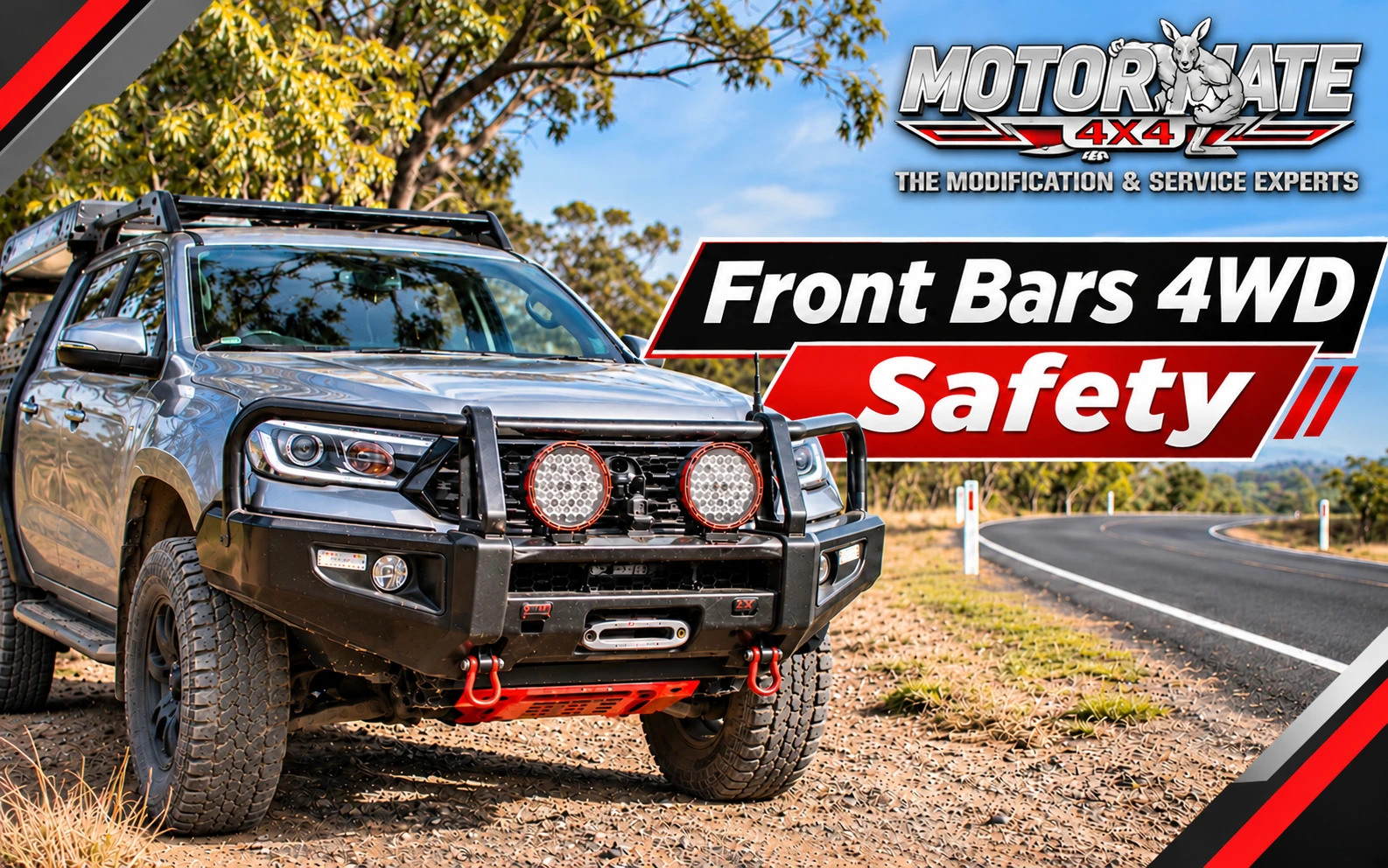
It’s late afternoon on a country road east of Perth, and a kangaroo bounds out of the scrub. If it hits your factory bumper, the radiator could be damaged and you could be stuck until help arrives. A front bar, also called a bull bar, is built to reduce that damage. But do front bars affect vehicle safety in other ways, and could the wrong one put your family at risk?
This guide covers what a bar protects and how it interacts with airbags and crumple zones. It also covers pedestrian safety, lights and sensors, weight, and WA’s rules. The checks apply to most utes and 4WDs, including the Toyota Hilux, Ford Ranger and BYD Shark 6.
Do front bars affect vehicle safety?
Yes, in both directions. A compliant bar built for your vehicle limits front-end damage from animal strikes and keeps factory safety systems working as designed. A poorly designed or badly fitted bar can change airbag timing and stiffen the crumple zone. It can also block lights or sensors and raise injury risk for pedestrians.
Which outcome you get depends on three things: the bar’s design, how it’s fitted, and whether it meets WA rules. The sections below take each risk in turn.
Front bar vehicle protection: what a bar actually protects
Behind your factory bumper sit the radiator, intercooler, headlights and bonnet. A bar’s role is front bar impact protection for those parts, so an animal strike is less likely to stop the vehicle. WA’s frontal protection guidelines describe this purpose directly: limiting cooling system damage so a vehicle isn’t left stranded. They also note protection from scrub on overgrown tracks.
A bar also gives you mounting points for a winch, recovery gear, and driving lights and other 4×4 accessories.
One limit matters, though. A bar reduces damage to the vehicle, but it does not make a collision safe. For the everyday benefits, see our guide on what a bull bar does on WA roads.
Airbags and crumple zones: how a front bar affects occupant safety
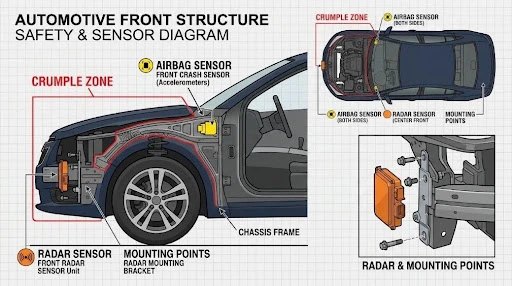
Your vehicle’s front end is designed to crush in a controlled way, and crash sensors time the airbags around that. A bar on weak or unsuitable mounts can change how the front end collapses and when the airbags fire. That’s why a bar’s engineering and mounting matter more than its looks.
WA’s circular CI-112D names three occupant risks from a poorly designed bar:
- Airbags deploying at the wrong time, which can cause added injury
- A more rigid front end, which reduces what the crumple zone can absorb
- A harsher impact for the people in the other vehicle
ADR 69 (full frontal impact) and ADR 73 (offset frontal impact) set minimum occupant protection levels. For vehicles covered by these rules, bar manufacturers must provide evidence that their product doesn’t interfere with occupant protection or airbag triggering. That evidence can come from physical tests or computer simulation.
Mounting strength is the detail to focus on. Research cited in CI-112D found it is one of the most significant factors in a bar’s effect on crashworthiness. Carefully designed mounts showed little or no effect on ADR 69 and ADR 73 performance. This is the core of 4×4 front bar safety: choose a bar the manufacturer states is airbag compatible for your model, fitted with its own mounting kit.

Pedestrian and road-user safety
A front bar can also strike a pedestrian or cyclist. CI-112D explains that injuries are usually least severe when the person rolls onto the bonnet, which is more likely when first contact is low. A tall or forward-leaning bar instead pushes the person forward and bends them over the top rail. That raises the risk of head, spinal and pelvic injury.
WA’s guidelines build on Australian Standard AS 4876.1-2002 and set these design limits:
- Low first contact: the first contact point can’t sit above a line set by the vehicle’s minimum dipped-headlight height.
- Follows the vehicle’s shape: the bar matches the front of the vehicle from above, the front and the side, and doesn’t lean forward.
- Height and rake (new models from 1 July 2019): no part sits more than 75 mm above the bonnet’s leading edge at the centre line. The upper structure also rakes back at least 5 degrees.
- Rounded edges: forward-facing edges have a radius of at least 5 mm, are free of burrs, and have no open tube ends.
WA uses ADR 92, the external projections rule, to judge whether any part of a bar is a dangerous projection.
Lights, visibility and driver assistance sensors
A bar sits where your lights, number plate and front sensors are, so it has to work around all three.
Lights and number plate
If the bar blocks any factory lights, extra ADR-compliant lamps must be fitted. Headlights must still meet ADR height rules. The number plate must stay visible, and its mounting hardware must be free of sharp edges.
Driver field of view
With the driver’s seat in its rearmost position, you must be able to see the road 11 metres ahead over the bar. Driving lights or accessories that block that view can’t go on the top rail. Plan any extra lighting around this rule before fitting.
Radar, cameras and parking sensors
If your vehicle has adaptive cruise control or autonomous emergency braking (AEB), the bar must not affect the radar and distance sensors they rely on. CI-112D also states that no factory safety feature may be made ineffective. For front cameras and parking sensors, the circular asks for bar designs that keep any impact to a minimum.
Sensor layouts can differ between variants of the same model. Our Land Cruiser bull bar listing, for example, notes that some camera or sensor variants need an adapter kit.
Weight, suspension and handling
A bar adds mass ahead of the front axle, and a winch adds more. That weight can lower the front ride height and change how the vehicle steers and brakes, especially when it’s loaded for touring.
CI-112D sets a clear limit. With the bar and accessories fitted, the loaded vehicle’s front axle weight must not exceed the manufacturer’s front axle load rating. The bar also uses up payload, so include its weight when you check you’re within GVM. Our guide to prioritising 4WD accessories covers which upgrades to plan first.
Combined modifications need care too. CI-112D notes that a suspension lift plus a bar can affect ADR wheel-coverage compliance. Check your axle figures first, then decide whether suspension lift kits suit your build.
Material choice changes the weight side of front bar impact protection:
Material | Weight trade-off | What to check |
Steel (mild or high-tensile) | Heaviest; uses the most front axle capacity | Front axle rating with a winch fitted; ADR 69 statement for your model |
Aluminium alloy | Lighter than steel | Winch and recovery point ratings, if you need them |
Polyethylene | Lightest | Coverage level, and whether it suits your mix of country and metro driving |
For vehicles that mostly stay in the metro area, CI-112D suggests a nudge bar style may suit better. Smaller options include our Hilux bumper guard and RAV4 front bumper guard.
4WD front bar compatibility: how to check a bar suits your vehicle
A bar suits your vehicle when it matches your exact model, carries a compliance label, works with your safety systems, and keeps you within your axle rating. Use this 4×4 front bar safety checklist in store or online:
- The label names your make and model years
- The manufacturer states airbag compatibility or ADR 69 compliance for your model
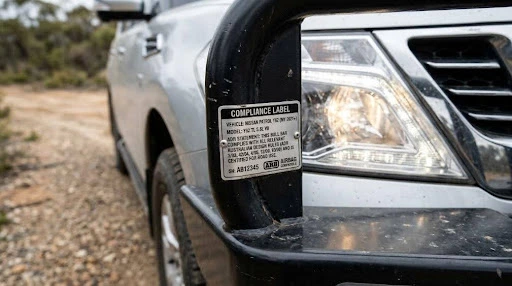
- A compliance label is fitted (see the WA rules below)
- The bar matches your variant’s radar, camera and sensor layout
- Lights, number plate and the 11-metre view stay clear
- Front axle load stays within its rating once a winch and lights are added
- It’s fitted with the supplied mounting kit, unmodified
When you’re ready, compare bull bars by vehicle.
Are front bars legal in WA?
Yes, when the bar meets Circular to Industry CI-112D, WA’s light vehicle frontal protection guidelines, which build on AS 4876.1-2002. A compliant bar needs no modification permit or prior approval. A non-compliant bar risks failing a vehicle inspection, attracting a defect notice, or being ordered off the vehicle.
CI-112D applies to light vehicles up to 4.5 tonnes GVM. It is now published by WA’s Department of Transport and Major Infrastructure (DTMI). Once a bar is fitted, the vehicle must still comply with all applicable ADRs.
What the compliance label must show
The label must be a durable plaque or label that you can read with the bar fitted, in letters at least 4 mm high. It must show:
- The vehicle make and model year(s) the bar suits
- The manufacturer’s business name
- A batch identification code
- A statement that the product and its fixings must not be modified
- A statement that the vehicle still complies with all applicable ADRs
Choosing front bars in Perth with Motor Mate 4×4
If you’re comparing front bars (bull bars) in Perth, our range includes model-specific bars for popular WA utes and 4WDs:
- M8 bull bar for the Toyota Hilux
- M8 bull bar for the Ford Ranger
- Commercial bull bar for the BYD Shark 6
- Bull bar for the Toyota Land Cruiser
Each of these listings states ADR 69 airbag compatibility on its product page.
Our Morley workshop also offers professional fitting for 4×4 accessories, so you can buy your bar and have the same team install it. When you book, tell us about any winch, driving lights or aerial so the fit is planned around your full setup. If your vehicle has sensors or cameras, we’ll check how the bar suits their positions.
Call us on 08 9375 9994, contact our Morley team online, or visit us at 277 Walter Rd W, Morley WA 6062.
FAQs
Is a second-hand bull bar legal in WA?
It can be, if it still meets CI-112D for your vehicle. Check that the label lists your make and model years, and that the bar is undamaged and unmodified. If you’re buying a used 4WD already fitted with a bar, a pre-purchase inspection can check its condition and fitment.
Are custom-made bull bars legal in WA?
Only if they meet CI-112D in full. For vehicles built to ADR 69 or ADR 73, the maker must also show evidence that the bar doesn’t interfere with occupant protection or airbag triggering. Where there’s doubt, CI-112D requires the supplier to contact DTMI’s Vehicle Safety and Standards section before fitting.
Can I mount a fishing rod holder or aerial on my bull bar?
Yes, if it’s mounted behind the bar’s front face so it can’t become a dangerous projection. CI-112D says rod holders must not stick out forward of the front face or above the top bar.
Will fitting a bull bar affect my new-car warranty?
Warranty terms vary between vehicle manufacturers. Check your warranty booklet, and ask your dealer and the bar supplier before fitting. Keep the fitting invoice and the bar’s compliance details with your service records.
Do older vehicles have to meet the 2019 bull bar rules?
The 2019 update to CI-112D added detailed height and rake limits for new vehicle models introduced after 1 July 2019. It added no new requirements for existing bar designs. Bars on other light vehicles should continue to meet the circular as they did under the previous version.